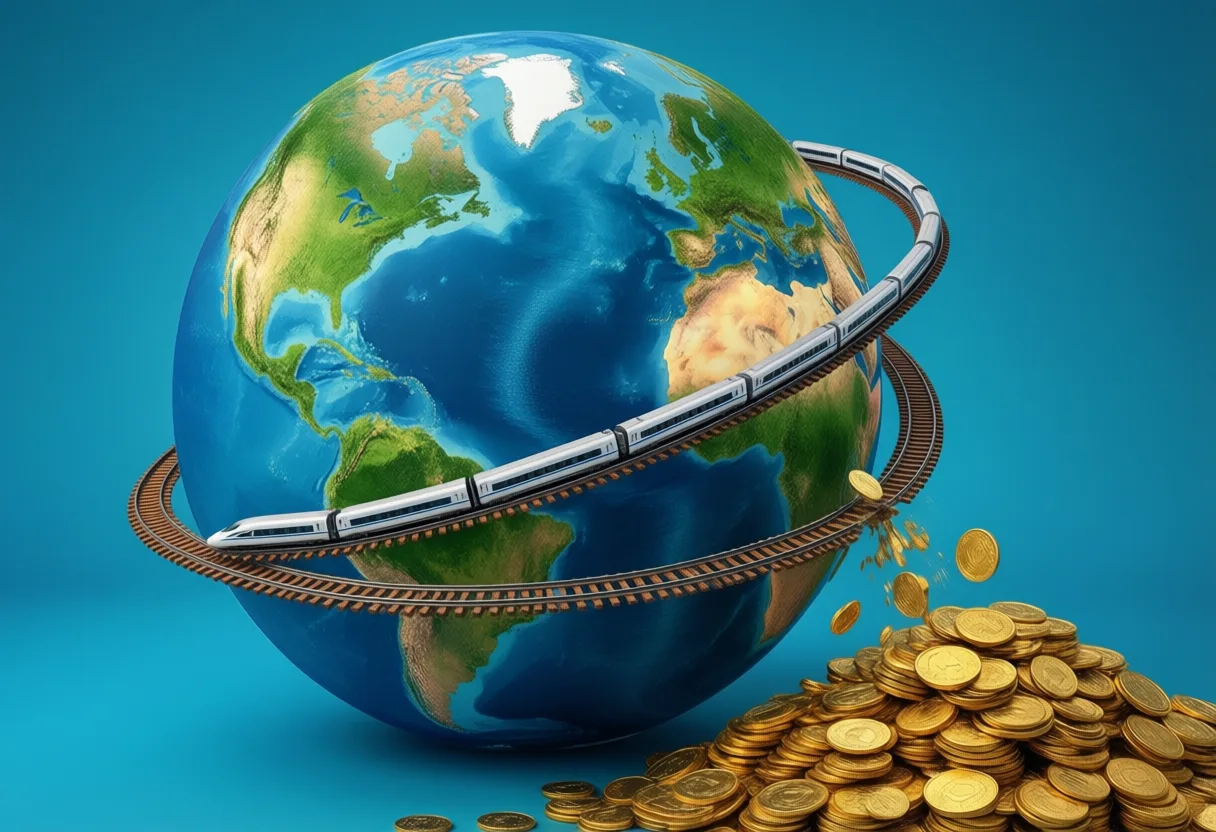
The world’s financial markets pulse like a network of beating hearts-each rhythm different, each vital. When one slows, another may quicken. That’s the power of global diversification: it doesn’t just spread risk, it opens doors to growth where others aren’t looking.
Diego Marquez here, reporting from a café in Lisbon where the espresso is strong and the Wi-Fi even stronger. I’ve watched local shop owners hedge inflation by pricing goods in euros and Dollars. They don’t wait for Wall Street to tell them the world is interconnected. Neither should you.
Why Global Exposure Matters Beyond U.S. Borders
Most American investors still keep the bulk of their portfolios tied to domestic stocks. It’s comfortable. Familiar. But comfort can be costly when the broader world offers dynamic economies, rising consumer bases, and innovation hubs far beyond Silicon Valley.
Think of it like planting crops in only one field. Even if that field has rich soil today, drought or pests could wipe out your entire harvest. The same goes for overrelying on a single market-no matter how dominant it seems now.
Global exposure isn’t about abandoning what works. It’s about acknowledging that Economic growth doesn’t stop at passport control. Countries with young populations, expanding infrastructure, and digital transformation are writing new chapters in wealth creation.
Emerging economies are building smart cities, launching fintech platforms, and adopting renewable energy at breakneck speed. These aren’t speculative bets-they’re measurable shifts reshaping long-term returns.
By engaging globally, investors position themselves not just to survive change, but to ride its momentum. That’s not chasing trends. That’s strategy.
And let’s be clear: the U.S. Market, while resilient, represents only part of the global opportunity set. Ignoring the rest is like reading only the first chapter of every book.

The Risk of Staying Home: Overconcentration in Domestic Markets
Putting too much faith in one country’s economy is a gamble few would admit to making. Yet millions do it daily by holding nearly all their investments in U.S.-based assets.
When a portfolio leans too heavily on domestic equities, it becomes vulnerable to localized shocks-policy changes, Regulatory swings, or sector-specific downturns. A recession here hits harder when there’s nowhere else to absorb the blow.
Consider how regional crises ripple through industries: supply chain disruptions, interest rate shifts, or labor shortages. These aren't isolated events-they test the strength of any concentrated bet.
Diversifying across borders acts as a natural shock absorber. Different regions respond differently to global forces. While inflation might pinch consumers in North America, it could coincide with wage growth in parts of Southeast Asia.
Markets move in cycles, and those cycles rarely align perfectly. One nation’s slowdown may come just as another enters its expansion phase. That misalignment is not noise-it’s opportunity.
Overconcentration also blinds investors to structural changes. Industries evolve, and leadership rotates. Today’s dominant tech giant may face stiffer competition abroad tomorrow.
Staying home feels safe-until the ground beneath you shifts. Then, you realize safety wasn’t in familiarity, but in balance.
7 Ways to Build a Globally Diversified Portfolio
1. Allocate Across Developed and Emerging Market Equities
Splitting your equity exposure between developed and emerging markets balances stability with growth potential. Developed markets-like Germany, Japan, or Canada-offer mature institutions and reliable corporate governance.
Emerging markets bring higher volatility, yes, but also faster GDP growth and expanding middle classes. Think of countries where mobile banking leapfrogged traditional banks, or where e-commerce adoption surged overnight.
A balanced mix allows you to capture both reliability and acceleration. You don’t have to choose one; thoughtful allocation lets you benefit from both.
Many index funds now offer this split transparently, making it easier than ever to gain broad access without picking individual stocks.
This isn’t speculation-it’s strategic inclusion based on economic reality.
2. Use Country-Specific ETFs to Target Regional Growth
Exchange-traded funds focused on specific countries or regions let you zero in on areas showing strong fundamentals. Want exposure to India’s digital transformation? There’s an ETF for that.
These tools allow precision without complexity. Instead of buying foreign shares directly, you get instant access through regulated U.S. Exchanges.
They track performance closely, charge low fees, and trade like any other stock. That means liquidity, transparency, and control-all critical for disciplined investing.
Targeted ETFs work best when used intentionally, not impulsively. Look for nations with improving business climates, sound fiscal policies, and growing trade relationships.
Avoid chasing short-term rallies. Focus instead on structural strengths-like education investment, export diversity, or technological adoption.
3. Invest in Multinational Corporations with Global Revenue Streams
Some of the most effective global exposure comes not from foreign stocks, but from familiar names doing business everywhere. Companies earning revenue across continents naturally hedge local downturns.
When sales dip in one region, they may rise in another. This built-in balancing act reduces volatility while maintaining growth exposure.
Look beyond headquarters. A U.S.-listed company deriving half its income from Asia or Latin America functions like a global player-even if its stock trades on the New York exchange.
These firms often have deeper resources, better risk management, and more diversified customer bases than purely domestic competitors.
You don’t need exotic instruments to go global-sometimes the best path runs right through your existing portfolio.
4. Consider International Real Estate Through REITs
Real estate isn’t bound by borders, and neither should your exposure be. International REITs let you own pieces of office towers in Singapore, warehouses in Rotterdam, or apartments in Sydney.
Property markets behave differently across regions. Rent growth, occupancy rates, and development timelines vary widely-creating non-correlated returns.
REITs handle the legal and logistical complexities so you don’t have to. You gain access to physical assets without dealing with foreign deeds or tenant disputes.
Plus, real estate historically provides income through dividends, adding another layer of return beyond price appreciation.
Like any asset, timing and selection matter. But spreading real estate holdings globally improves resilience against local housing slumps or policy changes.
It’s not about replacing your domestic REITs-it’s about complementing them.
5. Diversify Currency Risk with Strategic Forex Exposure
Money moves in multiple languages. Every time you hold an asset priced in yen, euros, or rand, currency fluctuations affect your returns-sometimes helping, sometimes hurting.
Rather than fear currency risk, manage it deliberately. Holding assets in various currencies can act as a natural hedge when exchange rates shift.
For example, if the dollar weakens, your foreign holdings may increase in value when converted back. That’s not luck-it’s structural benefit.
Some investors use currency-hedged ETFs to reduce volatility, especially in unstable environments. Others embrace the swing, viewing it as part of the global premium.
Either way, awareness is key. Ignoring currency is like driving at night with no headlights.
Treat forex not as noise, but as a dimension of return worth understanding-and occasionally shaping.
6. Tap Into Frontier Markets for Asymmetric Upside
Beyond emerging markets lie frontier economies-smaller, less liquid, but packed with potential. Nations with nascent stock exchanges, growing connectivity, and untapped consumer demand.
These aren’t for the faint-hearted. Liquidity can be thin, regulations unpredictable, and data scarce. But for those who research carefully, the upside can be outsized.
Frontier markets often grow quietly until they don’t. Then, everything accelerates-infrastructure spending, foreign investment, local entrepreneurship.
Allocating a small portion of your portfolio here isn’t reckless. Done prudently, it’s akin to venture capital within public markets.
Think of it as optionality: a modest stake that could pay off disproportionately if conditions align.
Just remember-frontiers require patience. They don’t follow quarterly earnings calendars. Success here rewards discipline, not urgency.
7. Rebalance Regularly to Maintain Geographic Balance
Markets move. Some regions surge ahead; others lag. Without rebalancing, your original global mix can drift into overexposure-defeating the purpose of diversification.
Rebalancing means selling high and buying low across geographies. If European stocks outperform, trim slightly. If Asian markets dip, consider adding.
It’s mechanical, not emotional-a routine check-up rather than a crisis response.
Automated platforms can help, but the principle remains human: stay intentional about your mix.
Set calendar reminders. Review twice a year. Adjust based on goals, not headlines.
Because true diversification isn’t a one-time decision. It’s a habit.

Common Myths That Deter International Investing
The idea that global investing is too complex or risky
Many believe investing overseas requires fluency in foreign law, tax codes, or trading systems. In truth, modern brokerage accounts make cross-border access simpler than booking a flight.
ETFs, mutual funds, and global REITs do the heavy lifting. You’re not wiring cash to Jakarta-you’re clicking a button on an app.
Yes, risks exist-political shifts, currency swings, regulatory changes. But these are known variables, not hidden traps. And they’re often priced into markets already.
Complexity is overstated. The real barrier isn’t knowledge-it’s perception.
With basic research and a clear plan, global investing becomes not just manageable, but logical.
Belief that U.S. Markets outperform everywhere long-term
It’s true the U.S. Has led in recent years. But past performance isn’t a promise. Markets rotate. Leadership changes.
Relying on continued dominance assumes no innovation elsewhere-an assumption history rarely supports.
Other nations develop competitive advantages too: manufacturing prowess, energy resources, digital infrastructure. These fuel returns over decades, not just quarters.
Chasing last decade’s winners leaves you exposed when the cycle turns.
Global diversification doesn’t mean betting against America. It means refusing to put all your faith in any single outcome.
That’s not pessimism. That’s prudence.
How Geopolitical Realities Shape Market Opportunities
Wars, elections, trade deals-these aren’t distractions from investing. They’re part of the landscape. Smart investors don’t ignore geopolitics; they interpret it calmly.
Conflict can disrupt supply chains or spike commodity prices. But it can also accelerate innovation-like alternative energy or cybersecurity spending.
Political transitions may create uncertainty, yet they often open doors for reform-privatization, deregulation, investment incentives.
Regions once avoided due to risk sometimes become hotspots for growth after stabilization. Perception lags behind reality.
The key is to avoid overreacting to headlines. Panic sells ads-but it ruins portfolios.
Instead, assess structural trends: demographics, urbanization, technology adoption. These move slower than news cycles but shape markets longer.
Geopolitical risk doesn’t cancel global opportunity. It redefines it.
Your job isn’t to predict every twist, but to build a portfolio flexible enough to adapt.

Practical Steps for Implementing a Global Strategy
Start with a core allocation framework
Decide how much of your portfolio should target international exposure. Many advisors suggest 30% to 50%, depending on risk tolerance and time horizon.
Break that down further: how much to developed vs. Emerging? How much to equities vs. Real estate?
Write it down. Make it repeatable. This becomes your anchor when emotions run high.
Use low-cost, broad-based funds to establish your base. Add targeted plays later, once the foundation is solid.
A framework turns intention into action-and consistency into results.
Monitor global economic indicators and policy shifts
Pay attention to inflation trends, central bank decisions, and employment data-not just in the U.S., but in major economies worldwide.
Trade balances, currency reserves, and government debt levels reveal underlying strength or strain.
These metrics don’t scream for attention. They whisper. But over time, they tell powerful stories.
Set up alerts. Follow reputable financial news. Don’t chase every blip-look for patterns.
Awareness isn’t obsession. It’s preparation.
Leverage tax-efficient accounts for cross-border holdings
Holding international assets in taxable accounts can trigger withholding taxes or complicate reporting. Using IRAs, 401(k)s, or other tax-advantaged vehicles can simplify things.
Some structures offer better treatment for foreign dividends or capital gains. Consult a tax professional familiar with cross-border rules.
Minimizing friction means more of your returns stay in your pocket.
Efficiency isn’t flashy-but compound it over decades, and it transforms outcomes.
Beyond the Hype: What Global Diversification Actually Delivers
Global diversification won’t make you rich overnight. It won’t beat every benchmark every year. That’s not its job.
Its real value lies in smoothing the journey-reducing gut-wrenching drops, capturing overlooked gains, and keeping you invested when others bail.
It delivers resilience. Optionality. Perspective.
Most of all, it reminds us that opportunity wears many flags. Wealth isn’t confined by borders. Neither should your portfolio be.
| Strategy | Key Benefit |
|---|---|
| Allocate Across Developed and Emerging Market Equities | Balances stability with high-growth potential |
| Use Country-Specific ETFs | Targets regional growth with precision and low fees |
| Invest in Multinational Corporations | Natural hedge against regional downturns |
| Consider International Real Estate Through REITs | Access global property markets with income potential |
| Diversify Currency Risk with Strategic Forex Exposure | Manages exchange rate swings as part of return |
| Tap Into Frontier Markets | Offers asymmetric upside with patient investing |
| Rebalance Regularly | Maintains intended geographic allocation over time |
Why Think Beyond Your Backyard?
Global diversification isn't just about fancy financial jargon-it's like building a travel bucket list for your portfolio. Did you know that the first known stock exchange outside Europe opened in Bombay (now Mumbai) way back in 1875? That’s decades before many modern financial hubs even got started. This early start highlights how investment opportunities have always popped up in unexpected corners of the world, long before instant digital trading made it easy to tap into them.
Markets Move to Their Own Beat
One cool perk of spreading investments internationally is that different markets often dance to different rhythms. For example, while U.S. Stocks might be taking a breather after a strong run, emerging markets in Southeast Asia could be gaining momentum thanks to rising consumer demand or tech innovation. This mismatch in timing-called low correlation-can help smooth out the bumps in your returns over time. It’s kind of like not putting all your concert tickets in one pocket; if you lose one, you still get to see the show.
Another fun twist: some countries offer dividends in local currency, meaning you might earn returns twice-once from the investment itself and again if that currency strengthens against your home currency. Of course, currency swings can go both ways, but that’s part of what makes global investing a dynamic way to grow wealth. Just remember, exploring beyond familiar markets isn’t about chasing trends-it’s about giving your money more places to thrive. Explore more stories, videos, and creators on Loaded.
Frequently Asked Questions
Why is global diversification important for investors?
Global diversification spreads risk and opens doors to growth in dynamic economies beyond domestic markets. It allows investors to benefit from economic shifts and market cycles that don’t align across regions.
What are the risks of keeping most investments in U.S. Markets?
Overconcentration in U.S. Markets makes portfolios vulnerable to localized shocks like policy changes or sector downturns. It also limits exposure to faster-growing economies and structural changes abroad.
How can investors gain global exposure without picking foreign stocks?
Investors can use multinational corporations with global revenue streams, international ETFs, and REITs. These instruments provide access to foreign markets through familiar, regulated U.S. Exchanges.
What role does currency play in international investing?
Currency fluctuations affect returns when assets are priced in foreign currencies. Holding assets in multiple currencies can act as a natural hedge, especially if the dollar weakens.
Not financial advice. This article is general information, not financial, investment, tax or legal advice. Talk to a qualified professional before making money decisions.
This article was produced with AI assistance. How Money Maker Magazine uses AI.
Diego explores the intersection of culture and commerce, reporting on how trends in travel, fashion, and dining shape consumer behavior and investment opportunities. His work reveals the economic engines behind everyday indulgences.